Last month, I took a trip out to Ukraine. I know, I know- half a day of travel to go to the second most dangerous country in the world, but I went because I felt like I wasn’t doing enough here, in the States. I wanted to see what the people there were going through, what it was really like.
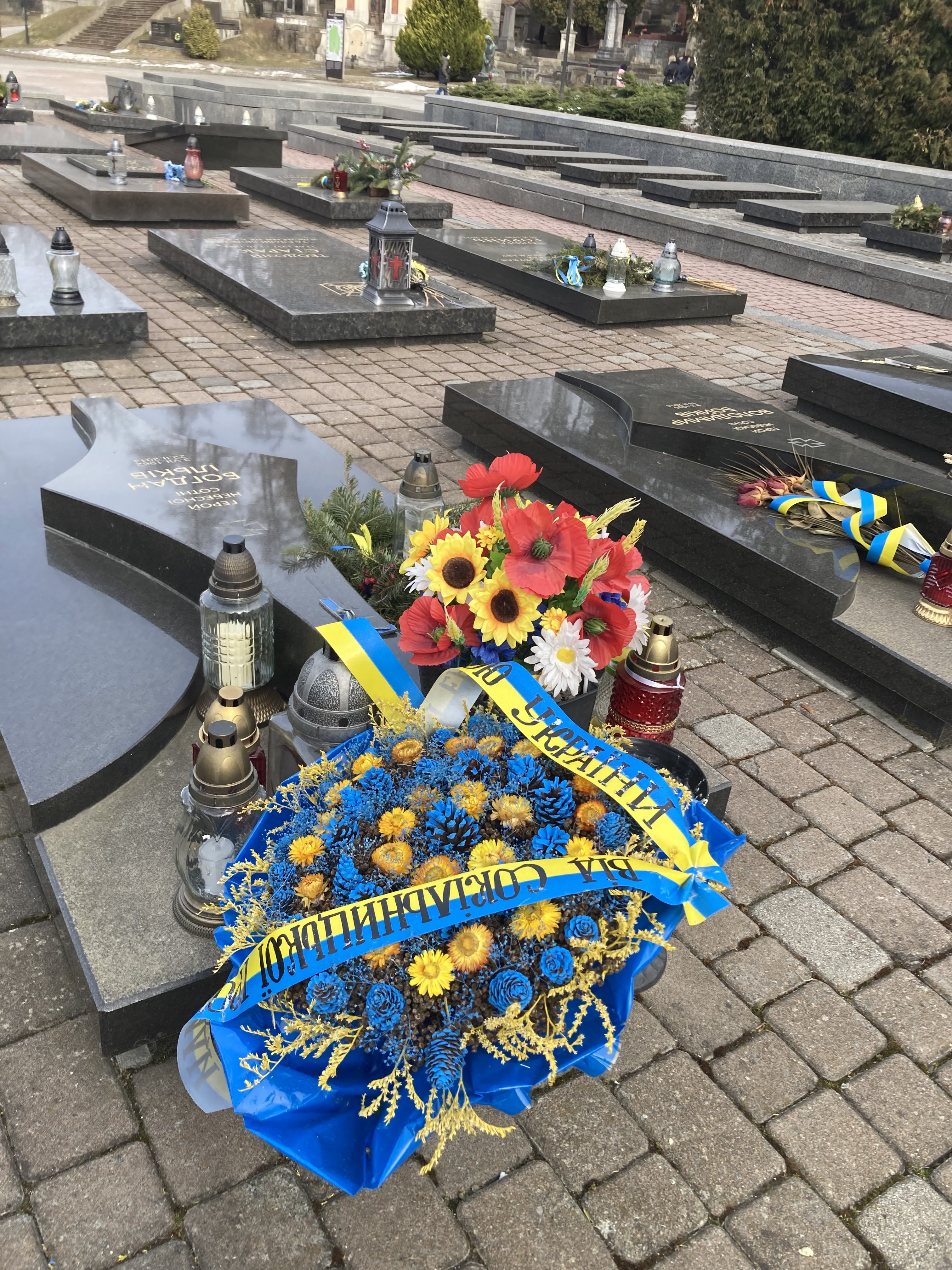
On my first day, I hit the Lychakiv Cemetery. It’s a Cemetery just on the outskirts of the Lviv city center. Unlike your normal Cemetery, there is a ticket fee as it’s registered as a museum, officially titled, “State History and Culture Museum-Reserve.”
Now, mind you. I do speak a little Ukrainian, but with all the cases, it is often very clear it’s not my first language. I went up to the ticket booth which is to the right of the entrance and said that I wanted one ticket. The man behind the desk kind of laughed and said, “студентка?” (Are you a student?) I shook my head, and said, “Ні, я волонтерка.” (No, I am a volunteer). He repeated it back to me, “волонтерка?” “Tak.” I responded (yes). Then he asked me where I was from, which for some reason, I can never understand it, but can say it fine; it’s one of those things where I can speak and read it, but understanding, I’m unsure. I looked at him and told him “Я не знаю” (I don’t know) and he said in English, “Where are you from?” I don’t know if he saw it, but I felt my face light up, knowing I can answer this (ha!) “Я з Америки” (I am from America).
He told me never mind on the ticket and I can explore the cemetery for free. I told him thank you, and I went on my way. This was one of my first experiences of talking to the Ukrainians and it was nice to see how welcomed I was, even as a foreigner with broken Ukrainian.


The cemetery dates back to the 18th century where many notable Ukrainians are laid to rest here. Many of these are military personnel with 1,000 soldiers killed since Russia’s 2014 invasion, including soldiers who died in the 1918-1919 Polish-Ukrainian War.
Others are more famous individuals like Ivan Franko- a poet, writer and activist or Solomiya Krushelnytska, a renowned opera star. They also have Yurii Shukhevych, a political prisoner and politician and Oleksandr Tysowskyj, the founder of Ukrainian Scouting (Plast).
The graves are in good condition, considering the years they’ve sat here and there was also someone in the front giving a tour of some kind.
Many of the graves have candles, flowers, photos or other items commemorating these people, and many of the tombstones look different. Some appear more like small homes


Others have intricately carves statues


Jesus is a common depiction with Ukraine being largely Christian, Roman Catholic, mostly.

And still others are made into large towers overlooking the other graves and tombstones
There was a silence in the air, not a creepy or scary atmosphere, but just a heaviness to the grounds. The grounds are about 100–104 acres in size and it’s just a surreal experience to be here and pay the respects.


Typically I conclude with “Do I recommend (place?)” but honestly, that feels weird to say on this post. This isn’t a restaurant, a garden or a traveling event. It’s a cemetery housing fallen soldiers and other Ukrainians who perished. So, instead- I will say this. I think that Lychakiv Cemetery is a great introduction to Lviv and is a place that you should visit. It’s a place that is heavy, but informative and historical. I think going here is needed because on a day-to-day basis, things can feel “normal” but we must not forget that underneath the surface, things are everything but. Don’t let the resilience of the Ukrainians lead you to think the war is forgotten or “not that bad.” Remember this place and the lives lost.
Website
Address: Mechnykova St, 33, Lviv, L’vivs’ka oblast, Ukraine, 79000
Hours: 9am-6pm Daily

Cheers friends & Travelers!
~Sho, Founder of Backroad Butterflies ~
Follow me on my socials: Instagram Facebook



Leave a Reply