Back in November, I had gone to visit Marseille, France. It’s not the uptown part of the country or the posh place- instead- it has a medium overall risk level, and reputation for crime. Having said that, it felt more like a less-than-fortunate city as opposed to the “ghetto.”
I hadn’t gone to Marseille specifically because I researched and really wanted that city of anywhere I could visit, but it happened to be where my cruise port was, and thus I was there! You can view my blog post about everything I did in Marseille, here– but today; I’ll just be delving into Cathedrale De La Major.
The Cathedral
The History
Things to do in Surrounding Areas
The Cathedral
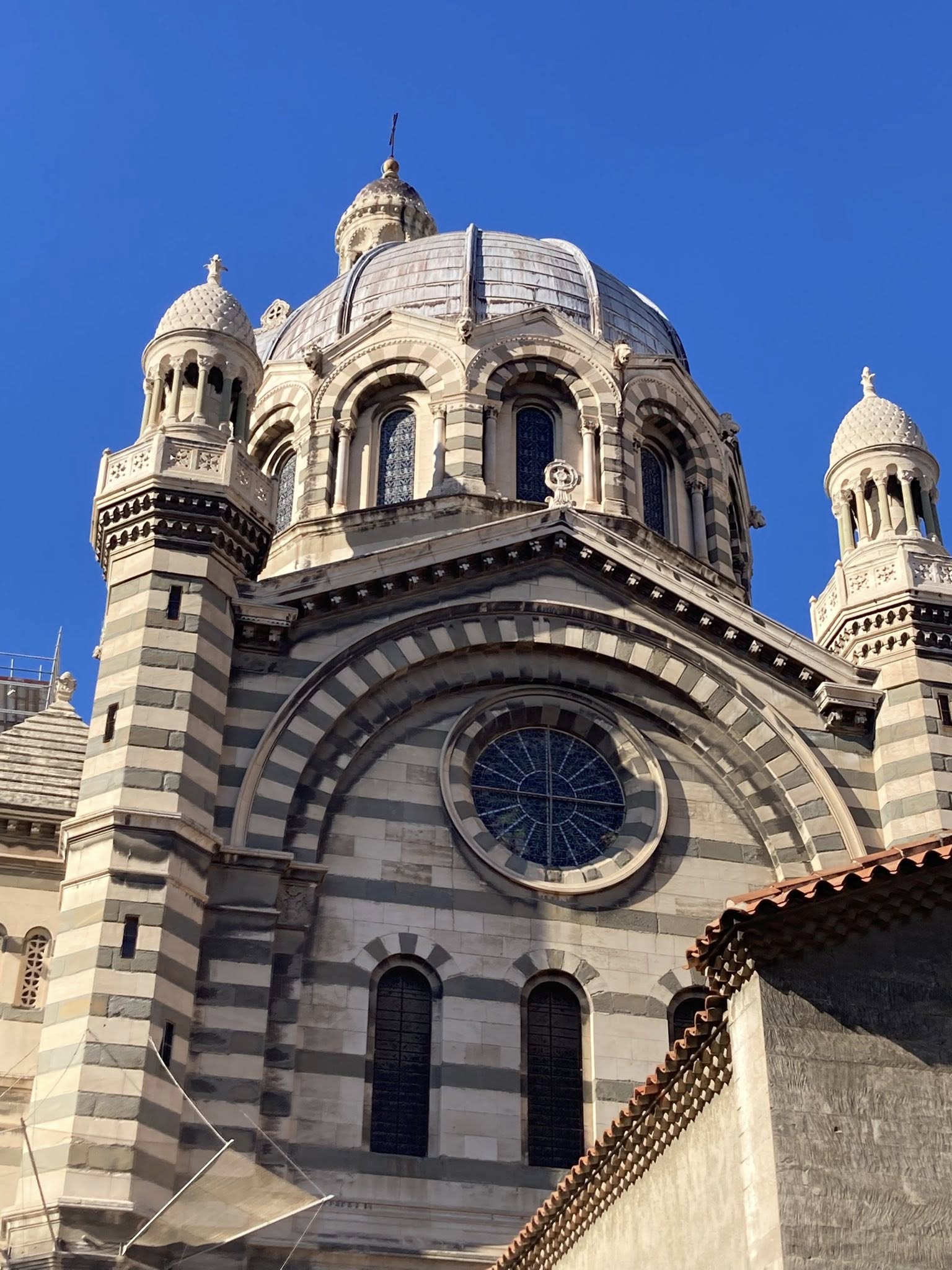
The Cathedral itself was a massive and gorgeous building. Something that you simply would never see where I’m from. The front was often crowded by tourists wanting to get the perfect entrance photo with the towering building, intricate designs near the arch and in my case- gorgeous weather.
Photos are allowed in most areas and entrance was free as well. There are few statues lining the building and depending on where you’re coming from, you might have to walk a little bit to get to the actual entrance! It is a total of 469 ft long (142 meters) and 231 ft tall (70 meters). The building could potentially hold up to 3,000 people at its full capacity. It’s one thing to read that, and complete different thing to stand face to face with this beautiful towering structure.


Inside, like many European churches and basilicas, you will find shrines lining the walls, representing the Christian/Catholic faith.

There are smaller rooms designated to different people from the Bible and even a large flowing sculpture with fish flowing down. (If you’ve read the Bible, you can connect that to when Peter couldn’t catch fish and Jesus had come to miraculously cast him a net of fish or of course, the famous fish and loaves miracle later on).
I’m not sure if this photo accurately captures it, but these are little fish. (likely made of wood or plastic of some kind)
The church is for Roman Catholics, and there are options for offering as well under the large Jesus -on-the-cross sculpture. (I didn’t take a photo due to a combination or respect and even with it being Jesus- not knowing if it would be appropriate to post a naked man on my blog??)


The History
The Cathedral actually has a pretty vast history. According to archaeological evidence, a Paleo-Christian church and baptistery existed here as early as before the middle ages. This cathedral is actually two different cathedrals side-by-side. The Vieille Major (medieval cathedral) and the Nouvelle Major (much bigger 19th-century cathedral).
The Vieille Major was built during the 11-12th centuries and built in a more Romanesque Style. During the 19th century, when the Nouvelle Major was built- some parts of the Vieille Major were unfortunately demolished to make room.
So why the new cathedral? By the middle of the 19th century, Marseille was experiencing significant changes in economic and population growth. The port was becoming increasingly important to trade with the Mediterranean and wider world. Because of this, the government wanted to have buildings that really reflected this growing importance. It wanted something symbolic, large and impressive.
The location of La Major was build near the new commercial port of La Joliette, where ships would be able to view the cathedral all the way from the water (I’m telling you, this thing is massive!). It was built specifically to announce Marseille’s wealth and importance to people arriving by sea.
The construction began in 1852- with the foundation stone being laid on September 26, 1852 by Lous-Napoléon Bonaparte, who would soon become Emperor Napoleon III. The architect was Léon Vaudoyer, designing the cathedral in a Romanesque-Byzantine/Neo-Byzantine style. It focused on architectural traditions of the Mediterranean and Christian East, which was unusual fro France, often copying Gothic styles.
The construction took over 40 years (which honestly, given the size and era (materials available) is not that long. Vaudoyer began the project but sadly died in 1872 before its completion. Henri-Jacques Espérandieu took over, who by the way! Is also responsible for the Notre-Dame de la Garde in Marseille. He worked on many of the structural elements but also died only two years late. Finally, Henri Révoil took over and completed the project. (Three’s a charm, I suppose?) It was completed in 1893 and elevated to the status of a minor basilica in 1896 by Pope Leo XIII and consecrated shortly after.
Today is stands in Marseille, close to the port. It has free entry and is a frequent attraction to both tourists and locals alike.
Things to do in Surrounding Areas
In terms of cities, I would say that Marseille is not that large. Depending on how much time you have there is a plethora of things to do nearby. Likely the closest attraction is Le Panier, a small neighborhood in France with restaurants in the town square with smaller stores down narrow roads coming from the town square.


There are also other religious sites in the area, such as Basilique du Sacre-Cœur-de-Jesus, Notre Dame de la Garde and Église Saint Vincent de Paul, (left to right) all of them have free entrance last time I checked as well making it a great place to visit for a quick tourist stop.


And lastly, two parks that I highly recommend are Parc Borely and Palais Longchamps. Depending on what day/time you arrive, you may even be able to visit the museums at Palais Longchamps for a small ticket fee, although inarguably worth it. Unfortunately when I went, I only had one day and couldn’t make it in time for the museums, but feel free to check out my blog on Palais here.


Parc Borely (top), Palais Longchamps (bottom)
So if you’re going to Marseille and have some time to explore- I HIGHLY recommend you visit Cathedrale De La Major. Tell me what you think and don’t forget to check out some of the other places I recommended!

Cheers Friends & Travelers!
~ Backroad Butterflies ~
Follow me on my socials: Instagram Facebook
Leave a Reply